
⚠️ Content Warning: This article discusses suicide, suicide prevention, and mental health crisis intervention. If you're experiencing a mental health crisis, call or text 988 for immediate support. Resources are also available at the end of this article.
TL;DR: The 988 Suicide and Crisis Lifeline prevented approximately 4,400 youth deaths in 2.5 years through friction reduction (changing from 10 digits to 3). States with higher call answer rates saw 11% fewer suicides. The program now faces funding collapse in most states despite proven effectiveness, revealing that society funds mental health interventions after tragedies occur, not before them.
Core Finding:
-
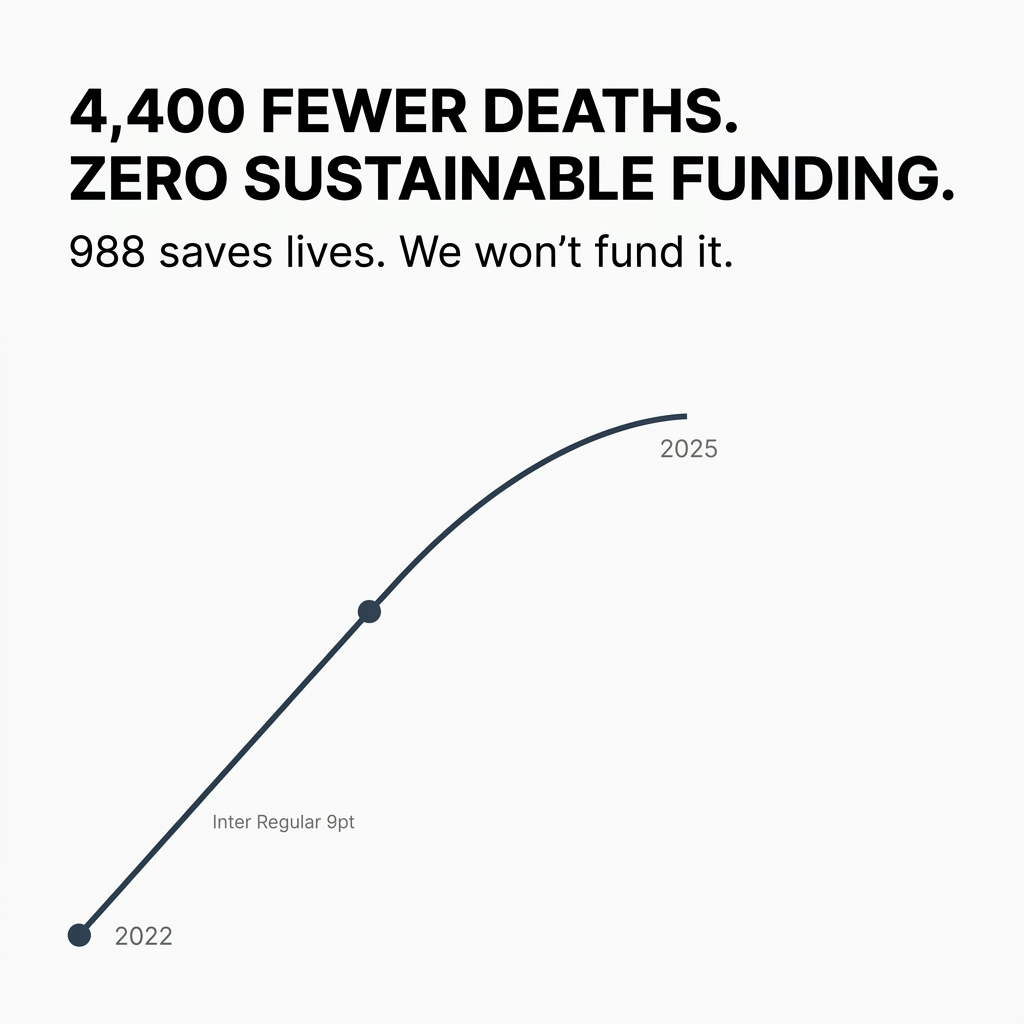
988 correlated with 4,400 fewer deaths (35,529 observed vs. 39,901 expected) among ages 15-34 from July 2022 to December 2024
-
States with largest call volume increases saw largest gaps between expected and actual deaths
-
Only 12 states have sustainable funding through telecom fees; most lack revenue models
-
The program received $1.5 billion federal investment but operates without guaranteed ongoing funding
-
Society operates on pain-threshold funding: prevention gets budgets only after deaths occur
The 988 Suicide and Crisis Lifeline prevented approximately 4,400 youth deaths in its first 2.5 years of operation.
The program is running out of money.
Society funds interventions after people die, not before. A JAMA study published data showing an 11% reduction in suicide deaths among people aged 15-34 following the July 2022 launch of 988. Researchers observed 35,529 suicides versus 39,901 expected deaths through December 2024.
The numbers work. The funding model doesn't.
What Is the Pain-Threshold Funding Model?
A mental health speaker and author of Transforming Stigma: How to Become a Mental Wellness Superhero describes a pattern repeating across college campuses nationwide. Universities decline prevention programs because they're not in the budget. A student dies by suicide. Funding suddenly appears.
“Society ignores it when it works,” he explains. “I would reach out to colleges and universities about hiring me to present on college mental health for the sake of suicide prevention, especially when it's known that an institution has had several on-campus suicides, and they decline because it's not in the budget. Then another suicide happens and magically, they reach out to me and there's a budget for it.”
Prevention has no budget until tragedy creates one.
Administrators know mental health matters. They have limited funds and feel pressured to address topics generating conversation. AI training. Diversity initiatives. Whatever dominates current discourse.
Mental health funding follows conversational trends rather than mortality data.
The 988 Lifeline shows what happens when proven interventions lose their cultural buzz. The program received roughly $1.5 billion in cumulative federal investment, according to Dr. Vishal Patel, the study's lead author. States with the largest increases in call volumes following 988's launch saw significantly larger gaps between expected versus actual suicide deaths.
The correlation is clear. Sustainability planning is not.
988 was federally mandated but came without federal funding for state call centers. Only 12 states have enacted a telecommunications fee to fund 988, similar to how 911 operates. Five states have recurring state funding. Most lack sustainable revenue models.
What happens when effective interventions disappear after losing their buzz?
They vanish completely. Then the pain becomes unbearable. Then they reappear.
“We do this all the time in our society,” the mental health speaker notes. “Preventative medicine is important and recommended, but often times people only take their health seriously once they have a heart attack.”
Bottom line: Institutions fund mental health prevention reactively, not proactively. Because funding follows cultural trends rather than mortality data, effective programs lose support when they stop generating conversational buzz.
What Happens During the Mortality Gap Between Funding Cycles?
Do the math on 4,400 lives saved over 2.5 years.
Approximately 1,760 deaths prevented annually. If funding collapses and the program operates at reduced capacity or disappears entirely, those people die. The window between defunding and tragedy-driven restoration creates a predictable mortality gap.
How long does that window last? It varies.
On college campuses, the cycle can take weeks, months, or an entire academic year. The pattern holds regardless of timeline. Prevention funding disappears. Tragedy strikes. Funding returns. The people who died during the gap remain dead.
We only invest after catastrophic failure, despite having data showing prevention works before the crisis happens.
The 988 program proves immediate access to crisis intervention reduces suicide deaths. The infrastructure to sustain that access remains unfunded in most states. As the American Foundation for Suicide Prevention reports, 988 has handled 19 million contacts, including 13 million calls since the 2022 launch. Volume increased approximately 20% year-over-year in 2025.
Demand is accelerating. Funding sustainability remains unresolved.
Bottom line: The mortality gap between defunding and refunding cycles represents preventable deaths. At 1,760 lives saved annually, program interruption means those people die while waiting for tragedy to restore funding.
How Does Friction Reduction Save Lives?
Changing the suicide prevention hotline from 10 digits to 3 produced an 11% reduction in youth deaths.
Friction reduction as a life-saving intervention.
Invisible friction points exist beyond memorizing phone numbers. People in crisis face mythology about what happens when they ask for help. Fear of forced medication. Concerns about privacy violations. Beliefs about losing control.
None of this is true.
“Mental health challenges of any type are confusing, complex, and frustrating,” explains the author of Transforming Stigma. “No one wants to be the weird one or outcast in a group.”
Two forces create stigma. Confusion breeds hesitation. Social exclusion breeds silence.
The 988 program strips away complexity. Three digits. Immediate human contact. No diagnosis required. The emergency services model bypasses stigma in ways traditional “see a therapist” messaging fails, framing crisis as a medical emergency instead of a character flaw.
“It has done a better job of that, but myths still exist and they are passed around,” the mental health speaker notes, quoting Robert A. Johnson's He: Understanding Masculine Psychology: “Often, when a new era begins in history, a myth for that era springs up simultaneously. The myth is a preview of what is to come, and it contains sage advice for coping with the psychological elements of the time.”
Myths shape behavior even when data contradicts them.
The 988 program demonstrates that reducing friction saves lives. State-level data shows that call answer rates correlate with suicide reduction. The 10 states with the largest increases in call volumes also saw the largest gaps between expected versus actual deaths.
Threshold effects in crisis response. Under-resourced programs produce zero population-level impact. Partial implementation delivers minimal results compared to fully-staffed services. Some coverage is potentially insufficient for measurable change.
You either answer the calls or you don't. There's no middle ground when someone is in crisis.
Bottom line: Simplifying access from 10 digits to 3 saved lives because friction kills. State data proves threshold effects exist: under-resourced crisis programs produce zero measurable impact because there's no middle ground when answering crisis calls.
Why Don't Crisis Services Generate Revenue?
Life-saving crisis services generate no income stream.
This creates systemic underinvestment in preventive care. One Texas crisis user noted that without a 988 conversation during a 3 a.m. anxiety crisis, she likely would have gone to the hospital for care instead. The crisis intervention prevented costly emergency department utilization.
The hospital would have generated revenue. The 988 call did not.
Research published in the New England Journal of Medicine found that although some preventive measures save money, “the vast majority reviewed in the health economics literature do not,” despite potentially delivering “substantial health benefits relative to their cost.”
Life-saving interventions must justify themselves economically instead of through mortality reduction alone.
Employer preventive care incentives typically deliver ROI within 3-5 years. The first year focuses on driving engagement and behavior change. Real financial benefits emerge between years two and five as chronic conditions are better managed.
This creates a temporal mismatch. Programs face defunding before demonstrating economic returns.
The 988 Lifeline operates under this constraint. Dr. Vishal Patel characterized the program as “one of the largest federal investments in suicide prevention in U.S. history,” with findings suggesting this investment “translated into measurable reductions in young adult suicide deaths.”
The investment worked. The sustainability model didn't account for ongoing operational costs without revenue generation.
Bottom line: Crisis services prevent costly hospital visits but generate zero revenue. This misalignment forces life-saving interventions to justify themselves economically before they reach the 3-5 year ROI window, creating predictable defunding.
How Are Specialized Services Politically Vulnerable?
The Trump administration officially terminated the 988 Suicide & Crisis Lifeline's LGBTQ+ Youth Specialized Services program on July 17, 2025.
The “Press 3” option had served over 1.3 million contacts—calls, chats, and texts—since the service launched in October 2022. Monthly calls had increased from 1,752 at launch to 69,057 answered contacts in May 2025 before termination.
Congress had allocated more than $33 million for LGBTQ+ services for 2025. The money was spent by June 2025, according to SAMHSA spokesperson Danielle Bennett, who stated that “continued funding of the Press 3 option threatened to put the entire 988 Suicide & Crisis Lifeline in danger of massive reductions in service.”
The federal budget maintained 988 overall funding at $520 million for fiscal year 2026 but omitted earmarked funding for LGBTQ+ services.
The option for 988 callers to press 1 for veterans or service members seeking specialized services remained in operation. The LGBTQ+ option was eliminated.
The National Suicide Hotline Designation Act was signed into law in October 2020 by President Trump during his first term. The bipartisan legislation noted that LGBTQ youths “are more than 4 times more likely to contemplate suicide than their peers” and stated that SAMHSA “must be equipped to provide specialized resources” to high-risk populations, including LGBTQ youths.
The removal of specialized services illustrates how high-risk population programs lacking legislative protection face elimination during administrative transitions. Identity-specific crisis services depend on administrative support rather than legal mandate.
Texas crisis centers saw another consequence from removing the LGBTQ+ option. It had routed calls from LGBTQ youth out of the 988 system to specialized organizations. Its cancellation meant a heavier workload for everyone in the system. Month-to-month data shows steady increases in calls to Texas crisis centers that were already overburdened before the removal of the LGBTQ+ subnetworks.
Eliminating specialized services doesn't eliminate the need. It redistributes the crisis to an already strained system.
Bottom line: Identity-specific crisis services lacking legislative protection face elimination during administrative transitions. Removing specialized services redistributes crisis calls to already strained systems without eliminating the need.
What Are the Limitations of Observational Studies?
The JAMA study that documented 4,400 fewer deaths is observational.
Researchers cannot prove 988 was the sole cause of the reduction. The study design shows correlation, not causation. Researchers found no similar changes in suicide deaths in England, where no comparable lifeline existed during the study period. This strengthens the correlation. But methodological certainty remains elusive.
This creates a policy challenge. Proving direct causation between crisis programs and mortality reduction is methodologically complex. Policymakers must make resource allocation decisions based on correlational evidence.
The data shows that states with higher 988 uptake saw larger reductions in suicide deaths. The data shows that simplifying access from 10 digits to 3 correlates with an 11% mortality decrease. The data shows that 4,400 fewer young people died than expected.
The data cannot prove that 988 caused these outcomes with scientific certainty.
You cannot run randomized controlled trials where some people in crisis receive help and others don't. Ethical constraints prevent the gold standard of causal research.
Decisions happen anyway. Funding gets allocated or withdrawn based on imperfect evidence. The question becomes whether correlational data showing 4,400 fewer deaths is sufficient justification for sustained investment.
Society answers that question through budget allocations, not scientific certainty.
Bottom line: Observational study design limits causal certainty. Ethical constraints prevent randomized trials in crisis intervention. Policymakers must allocate resources based on correlational evidence showing 4,400 fewer deaths.
How Does Mental Health ROI Create a Paradigm Shift?
The emerging requirement to justify suicide prevention through economic metrics reshapes how society values life-saving interventions.
Missouri funds 988 with money from general revenue. The House proposed more than $18.5 million for 988 and more than $22.3 million for associated crisis services for fiscal year 2027. The funding still needs to be reappropriated every year. The threat that it isn't renewed persists while the state grapples with a budget crunch.
Annual reappropriation creates perpetual vulnerability. Programs that save lives must rejustify their existence every budget cycle.
Despite the administration proposing flat funding for 988 at $519.6 million for fiscal year 2026, Hannah Wesolowski from the National Alliance on Mental Illness noted that “with a lot of the changes within HHS, we've seen a fair number of the staff within the 988 behavioral health crisis coordinating office depart the administration.”
Funding levels don't capture the full operational capacity picture. Staff departures reduce program effectiveness even when dollar amounts remain stable.
Dr. John Palmieri, acting director of SAMHSA's 988 Lifeline Office, stated that “this year, the 988 Lifeline continued to provide life-saving help to millions of people, with about a 20% higher volume of calls, texts and chats compared to the year prior.”
Demand is accelerating. Capacity is contracting. Funding sustainability remains unresolved.
This is mental health ROI as paradigm shift. Suicide prevention must justify itself through economic metrics rather than mortality reduction. The framework treats life-saving interventions as cost centers requiring return on investment rather than public health imperatives.
The 988 program prevents costly emergency interventions and hospitalizations. It generates no revenue. The cost avoidance model doesn't translate into budget justification when funding follows conversational trends rather than mortality data.
Bottom line: Annual reappropriation creates perpetual vulnerability. Staff departures reduce capacity even when funding remains flat. The paradigm shift treats suicide prevention as a cost center requiring ROI justification rather than a public health imperative.
What Is the Predictable Pattern in Behavioral Health Funding?
The 988 Lifeline follows a pattern visible across behavioral health infrastructure.
Initial federal investment launches the program. Demand scales rapidly. Long-term revenue planning lags behind operational needs. Funding shortfalls become foreseeable. The program faces collapse despite demonstrated effectiveness.
Then tragedy strikes. Then funding reappears. Then the cycle repeats.
This is the pain-threshold funding model applied to suicide prevention. We invest after people die, not before. The 988 data shows that prevention works before the crisis happens. The funding model operates as if prevention only matters after catastrophic failure.
4,400 fewer young people died in the first 2.5 years of 988 operation. That number represents lives saved through immediate, low-barrier access to trained crisis counselors. The emergency services model demonstrates that acute mental health crisis intervention functions differently than long-term therapy.
You don't need a therapeutic relationship to interrupt suicidal ideation at a critical moment. You need someone to answer the phone.
The state-level data proves this. Higher call answer rates correlate with greater reductions in suicide deaths. Threshold effects suggest that under-resourced programs produce minimal population-level impact. You either have the capacity to answer calls or you don't.
Partial implementation delivers zero measurable benefit when someone in crisis gets a busy signal.
The 988 program simplified access. It reduced friction. It saved lives. It faces predictable funding collapse because suicide prevention generates no revenue stream and must rejustify its existence through economic metrics every budget cycle.
This reveals how society actually values suicide prevention when forced to choose between competing priorities. The answer is uncomfortable. We value it after people die, not before.
The mythology persists. Prevention isn't worth the cost until tragedy proves otherwise. The data showing 4,400 fewer deaths challenges this mythology. The funding model ignores the data.
Society will rediscover the value of 988 after enough people die during the defunding period. The pain threshold will be reached. Funding will reappear. The people who died in the gap will remain dead.
This is the predictable pattern. The 988 Lifeline demonstrates that we know how to prevent suicide deaths at scale. We choose not to sustain the interventions that work.
The choice reveals the truth about how we value prevention. We don't. Not until the pain becomes unbearable.
Frequently Asked Questions
How many lives did the 988 Lifeline save?
The JAMA study documented approximately 4,400 fewer deaths than expected among people aged 15-34 from July 2022 to December 2024. Researchers observed 35,529 suicides versus 39,901 expected deaths, representing an 11% reduction.
Why does 988 face funding problems if the program works?
The program was federally mandated but came without federal funding for state call centers. Only 12 states enacted telecommunications fees to sustainably fund 988. Most states lack revenue models because crisis services generate no income stream despite preventing costly emergency interventions.
What is the pain-threshold funding model?
The pain-threshold funding model describes reactive funding where institutions allocate resources after tragedies occur, not before. Prevention programs lack budgets until deaths create political pressure for funding. This creates mortality gaps where preventable deaths occur during defunding periods.
How does simplifying from 10 digits to 3 save lives?
Friction reduction removes barriers to help-seeking. The simplified number increased call volume, and states with largest call increases saw largest gaps between expected and actual deaths. Accessibility matters because people in crisis need immediate, low-barrier access without memorization requirements.
What happened to the LGBTQ+ specialized services on 988?
The Trump administration terminated the Press 3 option on July 17, 2025, after serving 1.3 million contacts since October 2022. The $33 million allocated for 2025 was spent by June. The veteran services option (Press 1) remained operational while LGBTQ+ services were eliminated.
Why do specialized crisis services face political vulnerability?
Identity-specific programs depend on administrative support rather than legal mandate. Without legislative protection, specialized services face elimination during administrative transitions. Programs lacking permanent statutory authority operate at the discretion of current leadership.
What are threshold effects in crisis response?
Threshold effects mean under-resourced programs produce zero population-level impact because crisis intervention requires immediate response capacity. Partial implementation delivers no measurable benefit when callers get busy signals. You either answer calls or you don't.
Can observational studies prove 988 caused fewer deaths?
No. Observational study design shows correlation, not causation. Ethical constraints prevent randomized trials where some people receive crisis help and others don't. Policymakers must make funding decisions based on correlational evidence despite methodological limitations.
Key Takeaways
-
The 988 Lifeline correlated with 4,400 fewer youth deaths over 2.5 years, demonstrating that friction reduction in crisis access produces measurable mortality reduction.
-
States with higher call answer rates saw larger suicide reductions, proving threshold effects exist: under-resourced crisis programs produce zero population-level impact.
-
Society operates on pain-threshold funding where prevention receives budgets only after tragedies occur, creating predictable mortality gaps during defunding cycles.
-
Crisis services generate no revenue despite preventing costly hospital visits, forcing life-saving interventions to justify themselves through economic ROI rather than mortality reduction.
-
Only 12 states have sustainable funding through telecom fees. Most lack revenue models despite $1.5 billion federal investment and federally mandated implementation.
-
Specialized services for high-risk populations face political vulnerability without legislative protection, redistributing crisis demand to already strained systems when eliminated.
-
Mental health funding follows conversational trends rather than mortality data, meaning effective programs lose support when they stop generating cultural buzz.
⚠️ Crisis Resources:
If you or someone you know is struggling with thoughts of suicide, help is available:
-
988 Suicide & Crisis Lifeline: Call or text 988 (available 24/7)
-
Crisis Text Line: Text HELLO to 741741
-
Trevor Project (LGBTQ+ youth): 1-866-488-7386 or text START to 678-678
-
Veterans Crisis Line: Call 988 and press 1, or text 838255
