
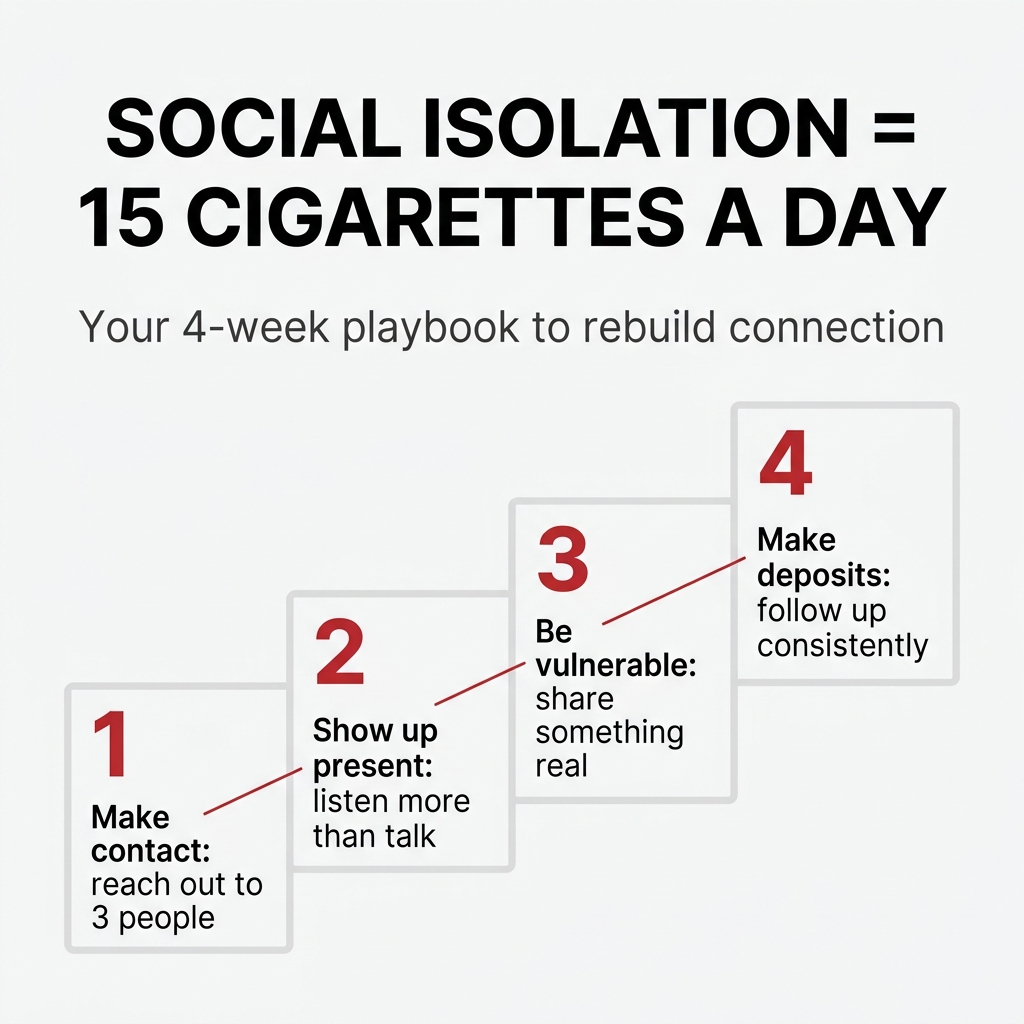
TL;DR: Social isolation increases mortality risk by 33%, comparable to smoking 15 cigarettes daily. Your brain is biologically wired for connection. Loneliness drives depression, anxiety, and cognitive decline. Building meaningful relationships through vulnerability, consistency, and genuine curiosity protects your brain and extends your life.
What You Need to Know About Social Connection and Survival
-
Social isolation increases death risk by 33%, with isolated individuals facing 70% higher mortality rates
-
Loneliness triples depression odds and quadruples anxiety odds
-
Your brain defaults to social thinking during rest because connection is survival
-
Quality social bonds reduce physical pain, build cognitive reserve, and buffer against brain disease
-
Starting with 20-minute coffee meetings builds the foundation for protective relationships
I realized something a while ago: you can't separate people's problems from mental health problems. They're the same thing.
When I looked around, the pattern was obvious. People who were doing well mentally had strong social connections. People struggling mentally didn't. Or when mental health declined, friendships disappeared.
Either way, the relationship was undeniable.
Then I started digging into the research. What I found was alarming.
How Does Social Isolation Affect Mortality Risk?
Social isolation increases your risk of dying by 33%. Comparable to smoking and obesity.
A Danish study found that the most isolated individuals had a 70% higher mortality rate compared to those with strong social networks. For isolated men, the 7-year mortality rate was 11% versus 5.4% for connected men.
The U.S. Surgeon General put it bluntly in 2023: chronic social isolation carries the same health risk as smoking 15 cigarettes a day.
Your brain needs people the same way it needs food and sleep. This isn't metaphorical. It's biological.
Bottom line: Social isolation is as deadly as smoking. The mortality data prove that the connection is a biological necessity, not a lifestyle preference.
How Does Your Brain Change Without Social Connection?
Social bonds shape how your brain functions.
Research shows that social engagement in older adults is associated with increased total brain and gray matter volumes. The areas that light up during social thinking are the same ones that protect against cognitive decline and dementia.
When your brain is at rest, it defaults to a configuration identical to when you're thinking about social situations. UCLA neuroscientist Matthew Lieberman suggests evolution made a bet that the best use of your brain's downtime is preparing for what comes next socially.
Your brain is wired to connect.
When you don't get a connection, things break down fast. Brain imaging studies reveal social pain activates the same regions as physical pain. Your brain doesn't distinguish between a broken bone and a broken relationship.
The reverse is also true. Research on romantic couples found that holding hands during pain created synchronized brainwave patterns associated with empathy. Greater brain synchrony was associated with less reported pain.
Connection literally reduces suffering.
The science: Your brain evolved to prioritize social connection. Social pain is perceived as physical pain, and social bonds produce measurable changes in brain structure and pain perception.
What Is the Link Between Loneliness and Mental Health?
The numbers on depression and anxiety are clear.
A 2026 study across eight countries found people reporting loneliness had almost three times the odds of meeting criteria for depression and nearly four times the odds of screening positive for generalized anxiety.
Among young adults aged 18-24, nearly one in two reported feeling lonely.
Harvard's 2024 “Loneliness in America” report found that 81% of lonely adults reported anxiety or depression. About 75% reported having little or no meaning or purpose in life.
The causality flows both ways. Loneliness induces depression and anxiety. Depression and anxiety deepen loneliness.
U.S. depression rates exceed 18% as of 2025. Up eight percentage points since 2015. An estimated 47.8 million Americans suffer from depression. Most of this increase happened after COVID-19. Loneliness reports have climbed back to 21% as of late 2024.
We're in the middle of an isolation epidemic.
The reality: Loneliness and mental illness fuel each other. With 47.8 million Americans suffering from depression and isolation rates climbing, we're facing a mental health crisis rooted in disconnection.
Why Do People Struggle to Build Deep Connections?
Here's what I've noticed: most people think they have good social skills. They don't.
I'm not saying this to be insulting. I'm saying it because it's one of the biggest barriers keeping people from building the connections they desperately need.
Watch what happens when you ask someone how they're doing. They'll start complaining about current events or their sports team. Or they'll give you the generic “Good, how are you?” The conversation stays shallow.
To really get to know someone and let them get to know you, you have to go deep. You have to be vulnerable.
The people who manage to build deeper relationships do something different. They're genuinely curious about others. They understand a conversation is a dance, not a monologue.
They're aware of how much time and space they take up in a conversation. They notice the energy they're bringing. People pick up on that.
You know when someone's genuinely present with you. It's instinctive. And you know how to measure the quality of that interaction, too—by how you feel afterward.
You talk about tough topics and still feel energized by the conversation. Or you have a pleasant chat with someone and feel completely drained.
That feeling is your barometer. You need it to know if something is working for you or not.
The truth: Most people lack the social skills needed for genuine connection. Deep relationships require vulnerability, curiosity, and awareness of conversational energy. Your post-conversation feeling is the barometer for relationship quality.
How Do Social Connections Build Resilience?
Stephen Covey introduced me to the concept of an emotional bank account in The Seven Habits of Highly Effective People. You make deposits into relationships over time. Sometimes you make withdrawals. But you always want to consistently make deposits, and other people do that with you, too.
Relationships build over time. You start by finding something you have in common with someone else. All relationships start this way.
When you're facing a difficult period—struggling with depression or anxiety—those accumulated deposits translate into a community you can lean on.
We're social creatures by nature. We want to feel like we belong. Even introverts like me. Even people who say they don't really like people.
Having those social connections doesn't necessarily make the struggle better. It makes it a little more manageable knowing you have support.
Research backs this up. Social connection increases cognitive reserve, your brain's ability to deal with damage or pathology. This protective effect helps mitigate the impact of brain diseases.
A four-year longitudinal study found that individuals who habitually use cognitive reappraisal (reframing events) developed stronger social connections and higher social status in college. Those using expressive suppression (hiding emotions) formed weaker connections.
Regulating emotions through social relationships has been linked to improved mental and physical health as well as enhanced social functioning.
The mechanism: Relationships work like emotional bank accounts. Consistent deposits create communities you can lean on during hard times. Social bonds increase cognitive reserve and protect against brain disease.
Why Is Loneliness a Public Health Crisis?
Social relationships influence mortality risk comparable to well-established risk factors like smoking and alcohol consumption. It exceeds the influence of physical inactivity and obesity.
In 2023, the World Health Organization declared loneliness a global public health concern and launched a commission to strengthen social connections.
Health professionals, educators, and the media need to take social relationships as seriously as other risk factors that affect mortality.
Brain health determinants include physical health, healthy environments, safety and security, lifelong learning, social connection, and access to quality services. All of these influence how our brains develop, adapt, and respond to stress and adversity.
The APA's 2025 Stress in America survey revealed that more than six in 10 U.S. adults feel societal division is a significant stressor. Half or more feel isolated (54%), left out (50%), or lacking companionship (50%) often or some of the time.
Adults with high loneliness levels were significantly more likely to report depression (65% vs. 15%), anxiety (60% vs. 24%), and chronic pain.
This isn't just affecting one generation. But younger adults are getting hit hardest.
The scope: Social relationships influence mortality more than physical inactivity or obesity. The WHO declared loneliness a global health concern because over half of U.S. adults report feeling isolated, left out, or lacking companionship.
Which Generation Suffers Most from Loneliness?
The 2024 Muse Brain Health Report shows that loneliness is particularly prevalent among younger generations: 43% of Gen Z and 40% of millennials feel isolated, compared to only 19% of Boomers.
Among those with brain health issues, 60% feel lonely most of the time, and 43% lack emotional support from family or housemates.
About half of college students (52%) report high levels of loneliness. One in three young adults (ages 18-25) feels lonely.
Harvard's report found that 44% of young adults feel like they matter to people only “a little” or “not at all.” And 86% of those who feel they don't matter reported feeling a lack of meaning and purpose.
A 2024 Deloitte survey of 23,000 respondents across 44 countries found that 46% of Gen Z reported feeling anxious or stressed all or most of the time.
When asked what they valued most in employers, Gen Z ranked work-life balance and mental health support above salary, career advancement, and company prestige.
They're telling us what they need. We should listen.
The data: Younger generations face the worst isolation. 43% of Gen Z and 40% of millennials report feeling isolated, compared to 19% of Boomers. Half of college students experience high loneliness, and Gen Z prioritizes mental health support over salary.
How Do You Start Building Social Connections?
If you're recognizing you're isolated and want to start building a protective social network, here's what you can do this week.
Start reaching out to people and scheduling plans to get together over coffee for twenty minutes.
Simple thing. Hard to do.
Ask three people you know. You might not even ask people you know that well. The purpose is to get used to it. It's going to feel awkward at first. Uncomfortable.
That's part of the process.
I built my entire podcast (Coffee with Mike: Well-Being and Belonging for Leaders) around this concept. A lot of the podcast was rooted in the coffee appointments I made with people early in my career, and how it made me feel like I belonged. It helped me develop a community and relationships I still have to this day.
Here's what to focus on over the next 30 days:
Week 1: Make Contact
Reach out to three people. Send a text, email, or message asking if they want to grab coffee or have a quick call. “Hey, want to catch up over coffee next week?”
Don't overthink it. Just send the message.
Week 2: Show Up Present
When you meet, practice being genuinely curious. Ask questions. Listen more than you talk. Notice how much space you're taking up in the conversation.
Pay attention to the energy you're bringing. Are you complaining? Are you going deep or staying shallow?
Check your barometer afterward. How do you feel?
Week 3: Be Vulnerable
Share something real. Not your whole life story, but something that matters to you. See how the other person responds.
Vulnerability is how you move from acquaintance to friend. Uncomfortable, but necessary.
Week 4: Make Deposits
Follow up. Send a message checking in. Share an article you think they'd like. Suggest meeting again.
Consistency matters more than intensity. Small, regular deposits build the emotional bank account over time.
Your action plan: Building protective relationships starts with 20-minute coffee meetings. Progress through curiosity, vulnerability, and consistency. The awkwardness is normal and necessary.
What Is the Most Important Thing to Know About Social Connection?
Social connection is one of the keys to happiness.
Sometimes, the difference between successful people and those who aren't lies in their social networks and social skills.
Your brain needs people to survive. Not in some abstract, philosophical way. In a measurable, biological, life-or-death way.
The research is clear. The data is overwhelming. Social isolation kills.
But the reverse is also true. Connection heals. It protects your brain. It reduces pain. It builds resilience. It gives you a community to lean on when things get hard.
Start small. Reach out to three people this week. Schedule twenty-minute coffee meetings. Practice being present and vulnerable.
It's going to feel awkward. Do it anyway.
Your brain is counting on it.
Frequently Asked Questions
How long does it take to build meaningful relationships?
Meaningful relationships develop through consistent deposits over time, not single interactions. Research shows that people who use emotional reappraisal build stronger connections over four years than those who suppress emotions. Focus on quality time and consistency rather than speed.
What if I'm an introvert who finds socializing draining?
Being an introvert doesn't eliminate your need for connection. We're all social creatures by nature. The key is finding quality over quantity. Even introverts need to feel like they belong. Start small with one-on-one 20-minute coffee meetings rather than large group settings.
How can I tell if a relationship is healthy or draining?
Use your emotional barometer. Check how you feel after each interaction. Healthy conversations leave you energized even when discussing tough topics. Draining relationships leave you depleted even after pleasant surface-level chats. Your feelings afterward tell you if the relationship is working.
What are the signs of poor social skills?
Poor social skills show up as one-sided conversations, shallow responses, a lack of curiosity, and an energy imbalance. People with weak social skills respond to “how are you?” with complaints or generic responses. They treat conversation as a monologue instead of a dance. They don't notice how much space they take up or the energy they bring.
Can social connection really reduce physical pain?
Yes. Brain imaging research on romantic couples shows that holding hands during pain creates synchronized brainwave patterns linked to empathy. Greater brain synchrony correlates with less reported pain. Your brain processes social pain and physical pain in the same regions.
How does loneliness cause depression and anxiety?
The causality flows in both directions. A 2026 study across eight countries found loneliness triples depression odds and quadruples anxiety odds. Depression and anxiety then deepen loneliness, creating a cycle. 81% of lonely adults report anxiety or depression, compared to much lower rates in connected individuals.
What should I do if my social connections are limited?
Start with three outreach attempts this week. Contact people you know (even casual acquaintances) and suggest 20-minute coffee meetings. The purpose is practice, not perfection. Expect awkwardness. Build from there with curiosity, vulnerability, and consistent follow-up.
Why do younger generations experience more loneliness?
Data shows that 43% of Gen Z and 40% of millennials feel isolated, compared with 19% of Boomers. Half of college students report high loneliness. Factors include digital communication replacing face-to-face interaction, decreased community participation, and higher rates of anxiety and stress. Gen Z now prioritizes mental health support and work-life balance above salary.
Key Takeaways
-
Social isolation increases mortality risk by 33%, equivalent to smoking 15 cigarettes daily or being obese
-
Your brain defaults to social thinking during rest because evolution wired the connection as a survival priority
-
Loneliness triples depression risk and quadruples anxiety risk, creating a bidirectional mental health crisis affecting 47.8 million Americans
-
Most people overestimate their social skills. Deep connection requires genuine curiosity, vulnerability, conversational balance, and energy awareness
-
Relationships function as emotional bank accounts. Consistent deposits over time create protective communities during difficult periods
-
Younger generations suffer most, with 43% of Gen Z and half of college students experiencing high loneliness levels
-
Start building connections by reaching out to three people for 20-minute coffee meetings. Progress through presence, vulnerability, and consistent follow-up despite initial awkwardness
